West Coast Coin and Currency Review 2026: Storefront-First Operator, Inventory Patterns, Trust Score
Overall rating: 4.0/5 (regional storefront-first dealer, not a gold IRA operator)
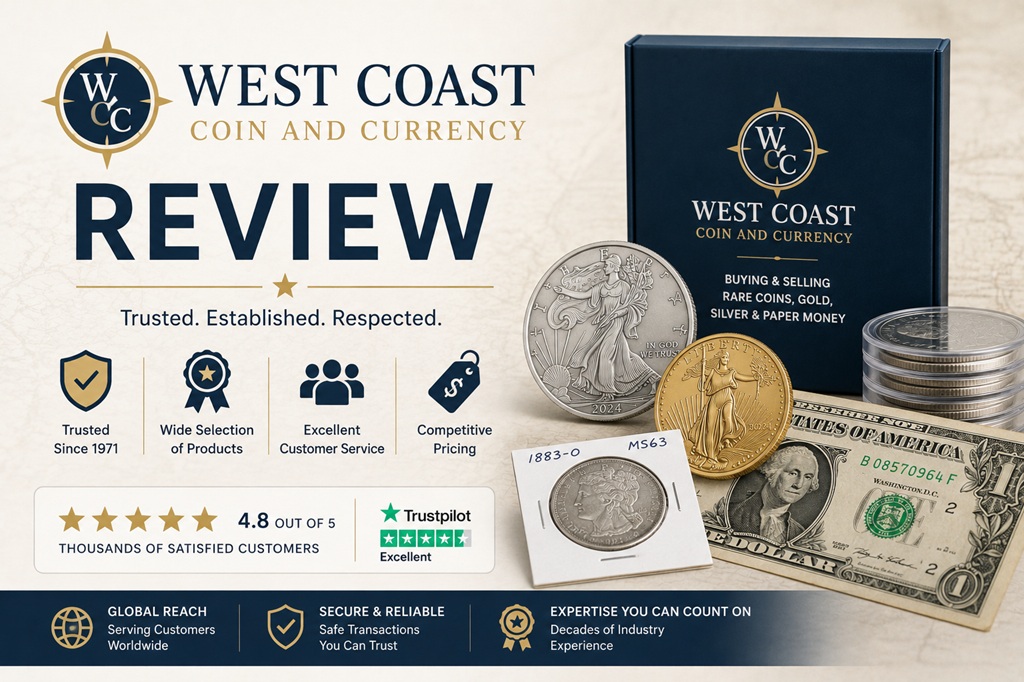
TL;DR: West Coast Coin and Currency is a Simi Valley, California, storefront-first precious-metals and collectible-coin dealer that buys and sells bullion, numismatic coins, and collectible currency. It is a Professional Coin Grading Service Authorized Dealer with an A+ Better Business Bureau letter rating. The eBay storefront under the Mint70 handle reports more than 137,000 items sold. It is not a gold IRA operator.
Disclosure: Investors Circle features companies that may provide compensation for click throughs. That model is how the site publishes CPA-bylined audits and gold investment product reviews without paywalling them.
Disclaimer: This article is educational and is not financial, tax, or legal advice. Consult a qualified professional before any precious-metals or retirement-account decision.
What West Coast Coin and Currency Is, and What It Is Not
Most readers searching for a single-dealer profile of West Coast Coin and Currency arrive expecting either a coin shop they can walk into or a gold IRA company. The operator is the first. It is not the second. The Simi Valley, California, dealer runs a brick-and-mortar storefront plus an eBay marketplace presence. The product set spans gold, silver, platinum, and palladium bullion, numismatic and collectible coins, and U.S. and international collectible currency. None of that catalog is structured around a retirement-account wrapper.
The distinction matters because the regulatory framework that applies to a full gold IRA operator does not apply to a storefront dealer like West Coast Coin and Currency. Per IRS Publication 590-A, the IRS requires IRA-held precious metals to be stored at an IRS-approved depository under the custodian's name, not at any address the account holder controls. The metals you walk out of the Simi Valley showroom with are personal-storage metals. They are not IRA-eligible by structure. The 28 percent (long-term capital-gains rate on collectibles in taxable accounts under IRC Section 1(h)(4)) applies at sale, and there is no custodial relationship at all.
What West Coast Coin and Currency sells is the underlying physical asset, with a storefront-first experience that bullion brokers and online-only dealers do not offer. The two-vehicle question framework that this site uses on every product evaluation applies here as well. If the goal is retirement-account diversification into physical metals, the gold IRA operator category is the correct vehicle. If the goal is personal-storage allocation, the storefront dealer category is one of the legitimate options.
Operating Model: Storefront-First in Simi Valley California
The operating model is the headline feature for buyers who value face-to-face transactions. West Coast Coin and Currency runs a single storefront in Simi Valley, California, with documented hours of Tuesday through Friday from 10 AM to 5 PM and Saturday from 10 AM to 4 PM. Monday is by appointment only. Sunday is closed. The structure is a small-business retail operation, not a national online marketplace.
The dual-channel structure pairs that storefront with an eBay marketplace presence under the Mint70 user handle. The marketplace presence carries reported sales of more than 137,000 (items across the operator's eBay history per the operator's own home-page disclosure). The number is high for a regional storefront dealer and reflects the long tail of collectible inventory that moves through the eBay channel rather than the walk-in counter.
The single-storefront posture is the structural differentiator. Online-only bullion brokers like JM Bullion and BullionVault scale across thousands of orders per day with no retail presence. Subscription gold operators deliver bars on a payment plan to residential addresses. National coin dealers like US Money Reserve run direct-mail and phone-room sales without a public-facing showroom in most markets. West Coast Coin and Currency does not compete with any of those structures. It serves the buyer who wants to look at the product before paying for it, and who values the over-the-counter conversation with a working numismatist.
The trade-off is regional reach. A storefront-first operator in Simi Valley, California, serves walk-in customers within driving distance of Ventura County and the greater Los Angeles area. National buyers reach the operator through the eBay channel, where the trust mechanics shift from face-to-face inspection to platform-mediated review aggregation. Each channel carries its own audit pillars.
Inventory Patterns: Bullion, Numismatics, and Currency
The inventory mix is the second structural feature. West Coast Coin and Currency carries three distinct product categories on the dealer side, each with a different regulatory and tax implication for the retail buyer.
The first category is investment-grade bullion. Gold, silver, platinum, and palladium bars and coins meeting the standard fineness thresholds. Under IRC Section 408(m)(3), IRA-eligible gold must meet the 0.995 fineness floor, silver the 0.999 floor, and platinum and palladium the 0.9995 floor. Investment-grade bullion sold over the counter at a storefront like West Coast Coin and Currency carries those same fineness specifications but is not held under an IRA custodian. The buyer takes physical possession. The metal is a personal-storage asset for tax purposes.
The second category is numismatic and collectible coins. Graded U.S. and international coins purchased for their collector value rather than for their bullion content. Numismatics are not IRA-eligible under the IRC Section 408(m)(3) carve-out because they do not meet the fineness-and-trustee-possession requirement. They are also not interchangeable with bullion at the spot price. Pricing on a graded numismatic coin is set against the grading slab, the population reports from PCGS or NGC, and recent auction-market comparables, not against the COMEX front-month settlement.
The third category is collectible U.S. and international currency. Paper notes priced for their numismatic value rather than for any underlying metal content. Currency is the lowest-overlap category with the gold IRA market and the most distinctive part of the West Coast Coin and Currency product set. Most precious-metals dealers do not run a currency book at all. A storefront-first operator carrying graded currency signals a working numismatic operation rather than a bullion-only mark-up business.
The inventory mix shapes the audit posture. A bullion-only dealer is graded primarily on spread above spot and on payment-clearing speed. A mixed bullion-and-numismatic dealer is graded additionally on grading-service authorization, on the population of graded inventory on hand, and on the integrity of the collectible-coin pricing. West Coast Coin and Currency clears the second screen by carrying authorized-dealer status with PCGS.
Trust Signals: BBB, PCGS, and Marketplace Volume
Three independent trust signals support the operator's profile. Each is verifiable on a primary or quasi-primary source.
The first is the Better Business Bureau A+ (the letter rating West Coast Coin and Currency carries on the BBB Simi Valley coin-dealers directory as of May 2026). The BBB letter is the most-cited reputation surface in the precious-metals retail category and is the closest thing to a third-party operational seal. The rating does not eliminate consumer-side due diligence. It does establish a documented complaint-resolution record and an active accreditation posture for a regional operator that would otherwise be hard to evaluate from outside the local market.
The second is Professional Coin Grading Service Authorized Dealer status, listed on the PCGS dealer directory. PCGS is one of the two largest third-party numismatic coin grading services in the United States. PCGS Authorized Dealers are required to follow the organization's grading standards and to maintain documented compliance with PCGS submission and authentication procedures. The status is not automatic. It is granted on operator application and maintained on continued compliance. For a buyer evaluating a regional storefront, the PCGS Authorized Dealer mark is a structural signal that the operator handles graded coins under industry-standard procedures rather than at the dealer's own discretion.
The third is the marketplace volume on eBay. The 137,000+ (items reported in the operator's eBay marketplace history) is high for a single-storefront regional dealer. The number does not directly tell the buyer how well any individual transaction will go. It does establish that the operator has run a multi-year, multi-thousand-transaction marketplace operation under platform-mediated review aggregation, where every transaction is rateable by the buyer and the average score is publicly visible. eBay seller-rating mechanics are not perfect, but they are harder to game than a static review wall on the dealer's own site.
The combined picture is a small regional operator with strong third-party-verifiable trust signals across the three most-cited reputation surfaces for the precious-metals retail category. We classify this operator as Tier B on our internal scoring framework. Not a national-scale buyer-protected channel, but cleanly above the unverified-and-unaccredited bottom tier that dominates the coin-dealer market.
How the Storefront-First Model Compares to Online-Only Bullion Brokers
The storefront-first model has structural pros and cons compared to the online-only bullion broker model that operators like JM Bullion and BullionVault run.
On the buyer-experience side, the storefront wins on the inspection question. A walk-in buyer can examine the actual coin or bar before paying. A storefront buyer can ask the dealer questions about provenance, condition, and pricing in real time. A storefront buyer takes physical possession at the moment of purchase rather than waiting for shipping. None of those are available through an online-only broker.
On the price side, the online-only broker typically wins. Online brokers run higher transaction volume against lower fixed overhead, and the spread above spot on common bullion products is usually tighter at JM Bullion or APMEX than at a regional storefront like West Coast Coin and Currency. The storefront premium is real and represents the cost of the in-person experience and the inventory-carrying overhead.
On the regulatory profile, both models sit in the same category. Neither is an IRA operator. Both serve personal-storage allocations. The buyer's tax treatment is identical at sale: 28 percent (the maximum long-term capital-gains rate on collectibles under IRC Section 1(h)(4)) for held-over-a-year metals in a taxable account, and ordinary-income treatment for short-term holds.
For a buyer choosing between the two models, the question is structural. If price is the dominant variable, online-only is the cleaner answer. If the in-person inspection or the local-numismatist relationship matters, the storefront is worth the spread. West Coast Coin and Currency sits in the storefront category cleanly. It is not trying to win on price.
What This Means If You Are Looking for a Gold IRA
If the actual goal is retirement-account diversification into physical metals, the storefront dealer category is not the right vehicle. A gold IRA requires a custodian, a depository, and an IRS-eligible product set held under the IRA's name, none of which a storefront-first dealer is set up to deliver.
The Tax Court drew the outer boundary in McNulty v. Commissioner, 157 T.C. No. 10. The court decided the case on November 18, 2021, with deficiencies of $250,558 (for tax year 2015) and $18,094 (for tax year 2016). An IRA owner cannot take actual and unfettered possession of the IRA assets, wrote Judge Goeke, summarizing the holding that closed the home-storage loophole some marketers were still pitching. The boundary, according to Judge Goeke, applies even when an intermediary single-member LLC is in the chain of custody. Walking metals out of a storefront and into a personal safe is the same boundary in different packaging.
For readers who want the operator-attested IRA path, the closest comparable in our 5-company funnel is Goldco at the $25,000 (operator-stated minimum) under a flat-fee structure that includes a $50 (one-time IRA account setup fee) plus a $30 (one-time wire fee), annual maintenance of $100 (per the operator's attested schedule), and storage of $150 (for segregated annually) or $100 (for non-segregated annually). The full attestation sits on the Goldco Review on this site. The broader 5-operator ranking is at the Best Gold IRA Companies aggregator.
The two-vehicle decision is the first one most precious-metals buyers should make. If retirement-account tax treatment is the goal, the gold IRA operator category is the answer. If personal-storage allocation is the goal, West Coast Coin and Currency and similar storefront-first dealers are legitimate options.
Frequently Asked Questions
Is West Coast Coin and Currency a gold IRA company?
No. West Coast Coin and Currency is a Simi Valley, California, storefront-first precious-metals and collectible-coin dealer. The operator buys and sells bullion, numismatic coins, and collectible currency through a brick-and-mortar storefront plus an eBay marketplace channel. None of that catalog is structured around a retirement-account wrapper. Under IRS Publication 590-A, IRA-held precious metals must be stored at an IRS-approved depository under the custodian's name, which a storefront dealer is not set up to deliver. If retirement-account treatment is the goal, the gold IRA operator category is the correct vehicle.
What is the BBB rating for West Coast Coin and Currency?
West Coast Coin and Currency holds an A+ letter rating with the Better Business Bureau per the dealer's directory listing in the BBB Simi Valley coin-dealers category as of May 2026. The A+ letter is the highest rating on the BBB scale and reflects a documented complaint-resolution record plus an active accreditation posture. The rating does not eliminate consumer-side due diligence on any individual transaction, and we recommend verifying the current BBB profile directly before any purchase.
What does West Coast Coin and Currency actually sell?
The product set spans three distinct categories. Investment-grade bullion in gold, silver, platinum, and palladium meeting the standard fineness specifications. Numismatic and collectible coins from the United States and international markets, with PCGS Authorized Dealer status supporting the graded-coin inventory. Collectible U.S. and international currency notes priced for numismatic value. The eBay marketplace channel under the Mint70 handle carries the long tail of collectible inventory that does not move through the storefront counter. The dealer also buys scrap precious metals and sterling silver items at the over-the-counter window.
Risk Warning: Precious-metals prices can be volatile. Collectible and numismatic coin values depend on grade, population, and auction-market conditions and may diverge from the underlying metal content. Past performance does not predict future returns. This article is educational only and not investment, tax, or legal advice. Consult a qualified professional before any precious-metals or retirement-account decision.
Request the Goldco IRA kit through the network's primary affiliate path to compare an operator-attested gold IRA against the storefront-dealer personal-storage path.
About the Author
Sean Webster, CPA is a Certified Public Accountant licensed by the Oklahoma Accountancy Board. He covers precious-metals product diligence, IRS-compliance posture for retirement accounts, and dealer-category audits for retail investors. His reviews focus on fee transparency, regulatory framework, and operator-attested versus aggregator-sourced verification.