SD Bullion vs Monument Metals 2026: A CPA Head-to-Head on Two Online Bullion Dealers
TL;DR: SD Bullion and Monument Metals are two reputable online bullion dealers, and neither is a gold IRA operator. SD Bullion, founded in 2012, leans on a lowest-price positioning and a large transaction volume. Monument Metals, founded in 2014, pairs bullion with a deeper rare-coin and specialty catalog. Both reward paying by check or wire with a published cash discount.
Disclosure: Investors Circle features companies that may provide compensation for click throughs. That model is how the site publishes CPA-bylined audits and gold investment product reviews without paywalling them.
Disclaimer: This article is educational and is not financial, tax, or legal advice. Consult a qualified professional before any retirement-account decision.
Two Bullion Dealers and One Common Misread
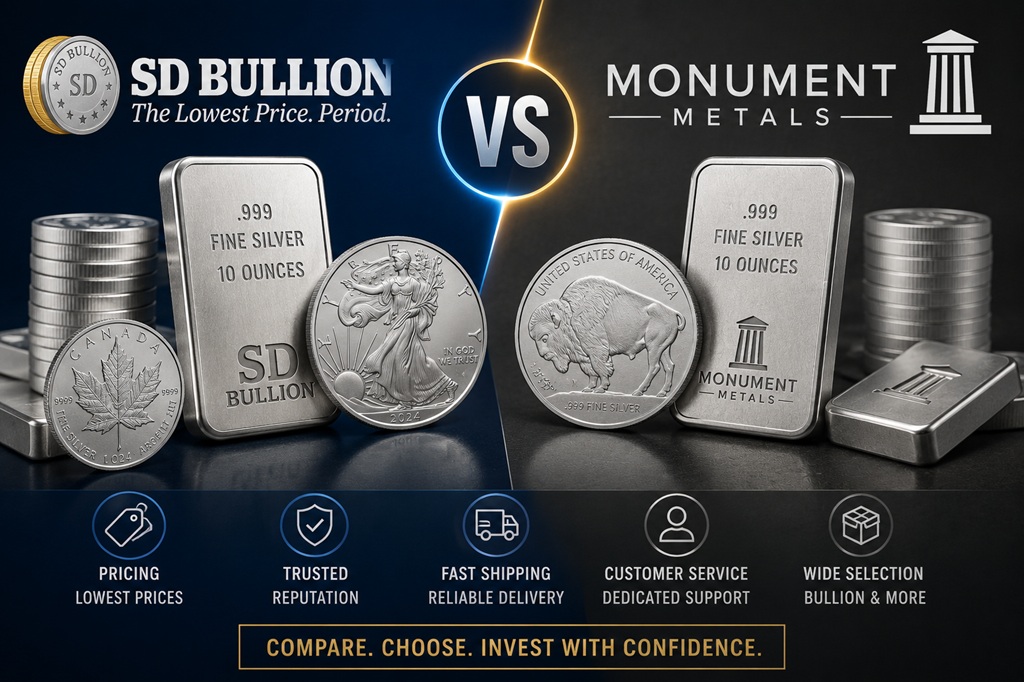
Both companies in this comparison sell physical coins and bars to the public at a markup over the spot price, which is a fundamentally different product from a self-directed retirement account. SD Bullion and Monument Metals are online retailers. They ship metal to a doorstep or to a storage account, take payment by card or wire, and quote a premium that floats with the daily spot market. What they do not do is run the custodial and depository machinery a gold IRA depends on, and treating a dealer purchase as if it were a retirement-account move is the error that costs new buyers the most.
Why the line matters comes down to one number on a future tax return. Coins kept in a drawer or a home safe are collectible property, and a long-term sale tops out at a 28 percent (collectibles ceiling) federal rate, whereas the same metal inside a qualified wrapper postpones the tax entirely. For a buyer who simply wants tangible bullion to hold, either of these dealers fits the bill. For a buyer trying to shift retirement dollars into metal, neither dealer alone is the answer, and the back half of this piece walks through what is.
What follows ranks the two on the things that genuinely differ: how old and how large each operator is, what the catalog covers, how payment and shipping work, where premiums and buyback land, and how the independent reputation surfaces read. Rather than crown one winner for everyone, the closing verdict sorts the two by the kind of buyer each suits best. So before you load a cart, ask what the metal is actually for.
The Ownership and Background Behind Each Dealer
The corporate footing behind each operator is where these two dealers genuinely diverge, so it is worth stating each one plainly. They are independent companies of different ages, different scale, and different founding stories. That distinction matters to a buyer who cares who stands behind the operator and how long it has been doing this.
SD Bullion is an online precious-metals dealer co-founded in 2012 by Dr. Tyler Wall and headquartered in Ottawa Lake, Michigan. The company was built around a stated mission to offer precious metals at the lowest possible prices, paired with fast, secure shipping and customer service. Wall serves as founder and president and was named an Entrepreneur Of The Year 2023 Michigan and Northwest Ohio award winner by Ernst and Young. The lowest-price positioning is the dealer's central marketing claim, and a careful buyer should treat it as a promise to verify against live premiums rather than a settled fact.
Scale is the second SD Bullion fact worth noting. The dealer reports that since 2012 it has shipped more than 1,500,000 orders to more than 400,000 customers, representing more than 4,000,000,000 dollars in transactions. SD Bullion also runs its own storage facility, SD Depository, with holdings insured through Lloyd's of London, and it stocks IRA-eligible bullion products for buyers who pair them with a separate custodian.
Monument Metals is a precious-metals dealer organized as a limited liability company, founded on September 17 of 2014 and headquartered in Frederick, Maryland. It is family-owned, founded by Jonathan Swyers, who serves as chief executive officer, with principals who traded in the wholesale numismatic and bullion market before selling to the general public in 2014. The dealer operates in the coin-dealer and bullion-coin-dealer categories, and its catalog reaches past mainstream bullion into rare coins, gold jewelry, and silver flatware, a wider numismatic and specialty shelf than SD Bullion's lowest-price bullion focus.
Product Range, Minimums, and Payment Methods
Both dealers cover the core metals a buyer expects, and the practical difference is the shape of the catalog. SD Bullion concentrates on mainstream gold, silver, platinum, and palladium bullion, with the lowest-premium positioning steering the product mix toward high-volume coins and bars. Monument Metals carries the same four metals in bullion form, plus a deeper rare-coin and specialty shelf that includes numismatic issues, gold jewelry, and silver flatware. A buyer chasing the cheapest ounce of standard bullion and a buyer hunting a specific collectible coin are not shopping the same way.
Payment terms are where both dealers publish a measurable lever, and the structure is similar on each side. SD Bullion applies a 4 percent (a cash discount) reduction on payment by bank wire, paper check, or electronic check, while credit-card and PayPal orders pay the standard rate. The dealer ties payment method to order size: bank wire is required above 20,000 dollars and is not offered below 2,500 dollars, paper checks are accepted up to 20,000 dollars, electronic checks up to 10,000 dollars, and PayPal up to 500 dollars. SD Bullion also accepts cryptocurrency and major credit cards.
Monument Metals runs a comparable 4 percent (a cash discount) reduction on payment by certified check, cashier's check, personal check, electronic check, wire transfer, or money order. One structural quirk matters: the list prices Monument Metals shows on each product page already reflect that 4 percent discount, so a credit-card or PayPal buyer pays a surcharge back up to the standard price rather than seeing a separate discount applied at checkout. Credit cards, PayPal, and ACH transfers are accepted. The practical math is the same at either dealer: paying by wire rather than card on a 10,000 dollar order captures 4 percent (a 400 dollar reduction at that order size), which usually dwarfs the day-to-day premium gap between the two. Read each dealer's payment page before building the cart, because the headline price is not the price a cash-paying buyer or a card-paying buyer actually settles.
Shipping, Buyback, and Pricing Reputation
Delivery is effectively a wash. Each dealer waives shipping and fully insures any order above 199 dollars, with SD Bullion attaching a flat 9.95 dollar (an insured rate) charge under that line. Because the 199 dollar (a shared free-ship floor) cutoff is the same on both sides, almost any realistic bullion order lands in free-shipping territory at either store. Discreet, insured packaging is standard at both, which is the bare minimum any serious online dealer is expected to provide rather than a point of differentiation.
The premium question is the one shoppers fixate on, and it resists a tidy answer because the number resets every trading day. Spot markups swing with demand, product type, and quantity, so no single dealer wins on price across the board once a live quote loads. SD Bullion stakes its brand on the lowest-premium claim, and on mainstream high-turnover coins that claim tends to translate into a slim edge on the sticker. Retail gold coin markups generally fall in a 3 percent (a typical low-end markup) to 8 percent (a typical high-end markup) band over spot, with silver running higher, so even a fraction of a point compounds on a large order in a way it never does on a single coin. Monument Metals leans on catalog depth and service instead, so where it pulls ahead is on scarce numismatic pieces rather than the cheapest generic ounce. Volume pricing applies at both, dropping the per-unit premium as the quantity climbs, which is why a bulk order beats a one-off purchase at either store.
Selling back is the mirror image of buying in, and Monument Metals operates a working buyback desk that posts a live repurchase price on metal it originally sold. What a round trip actually costs is the gap between that sell-back quote and the purchase premium, a figure that shifts with the product and the market rather than holding to any published rate. Pull a current buyback number before you commit rather than guessing, since that spread, not the advertised premium on the way in, is what decides the true cost of a quick in-and-out at either dealer.
Reputation and Independent Review Signals
Third-party trust signals come out strong for both, with no red flag on either profile. SD Bullion has carried Better Business Bureau accreditation since April of 2014 and holds an A-plus rating. The Better Business Bureau shows Monument Metals accredited since May 11 of 2017, also at A-plus, the later date simply tracking the Maryland dealer's younger founding. Checking that BBB profile is the first move a careful buyer should make on any dealer, and here both clear it without issue.
On the consumer-review platforms, SD Bullion's Trustpilot profile sits near the low-to-mid 4 range across more than 2,700 reviewer entries, which works out to roughly 80 percent (a four-of-five-star equivalent) and places it comfortably in the favorable tier. Monument Metals also carries a large body of customer reviews, though its aggregate score is reported inconsistently across platforms, ranging from a strong four-star tier on some surfaces to a more average score on others. Where a third-party page cites a precise score or review count, treat it as a contested snapshot rather than a fixed figure, and weigh the rating tier and the volume of feedback over any single headline number.
Reputation, in the end, leaves the two roughly level. Each is an A-plus accredited dealer with years on the clock and a deep well of customer feedback. SD Bullion brings the longer history and the bigger reported transaction figure, Monument Metals brings solid accreditation and a broader product shelf. With so little daylight between them on trust, the deciding factors have to come from elsewhere, namely the catalog, the live premium, and the exact products a buyer is after.
Side-by-Side Comparison: Which Dealer Fits Which Buyer
Here are the verified, sourced differences laid out side by side for a quick read.
| Factor | SD Bullion | Monument Metals |
| Founded | 2012 | 2014 |
| Headquarters | Ottawa Lake, Michigan | Frederick, Maryland |
| Positioning | Lowest-premium bullion | Bullion plus deep rare-coin catalog |
| Free shipping floor | 199 dollars | 199 dollars |
| Cash discount | 4 percent wire, check, or crypto | 4 percent check, wire, or money order |
| Storage option | SD Depository, Lloyd's insured | None published |
| BBB | A-plus, accredited since 2014 | A-plus, accredited since 2017 |
| Trustpilot | Low-to-mid 4 tier, 2,700-plus reviews | Large volume, score reported inconsistently |
The recommendation sorts by what a buyer values most. If the goal is the cheapest path into standard, high-turnover bullion, SD Bullion is the logical choice, since its lowest-premium brand, optional in-house vaulting, and longer history all favor a cost-minded buyer who funds by wire or check. If the goal is reaching past plain bullion into scarce coins and specialty pieces, Monument Metals wins on catalog breadth, with the caveat that its listed prices already fold in the cash discount, so a card payer pays up rather than down. Neither is a risky pick, which makes this a question of fit, not of who can be trusted.
From a Bullion Purchase to a Gold IRA
For a reader saving toward retirement, this is the turn that matters. Buying from either dealer is a taxable transaction, and no amount of it improves the tax standing of an IRA. When the real objective is moving retirement money into metal rather than building a personal stash, the vehicle is a self-directed gold IRA, opened through an operator that lines up an approved custodian and an approved depository on your behalf.
A gold IRA runs on three roles that stay separate by design. IRS Publication 590-A frames it plainly: the custodian holds legal title to the account assets, the depository holds the physical metal, and the dealer that supplies the bullion is a third party to both. SD Bullion can sell IRA-eligible product and even runs its own insured vault, and Monument Metals can supply eligible coins too, yet neither stands in for the custodial layer the account requires. Filling that missing layer is precisely the job the dedicated gold IRA operator exists to do.
The disciplined next move for a retirement buyer is to weigh dedicated operators on fee clarity and custody transparency, not on premium alone. Per Money.com benchmarking, a transparent operator typically charges 100 dollars to 150 dollars a year in storage and a 50 dollar to 200 dollar setup fee. Request a free operator kit, read the fee schedule and the eligible-product list line by line, and measure it against the operators graded in the best precious metals dealers audit and the best gold IRA companies on this site.
The IRS Rules That Govern Any Gold IRA
Whichever operator a reader eventually chooses, three federal rules govern the account, and they are the rules a dealer purchase cannot satisfy on its own. Eligibility is the first. IRC Section 408(m)(3) excludes IRA-eligible bullion from the collectibles prohibition only when the metal meets a minimum fineness and is held by a qualifying trustee. The gold floor is 0.995 (a 99.5 percent standard), the silver floor is 0.999 (a 99.9 percent standard), and the platinum and palladium floor is 0.9995 (a 99.95 percent floor). The one statutory exception is the American Gold Eagle from the U.S. Mint at 91.67 percent (its statutory purity), eligible only because the statute names it directly, while the South African Krugerrand shares that purity and is not eligible because the statute does not enumerate it.
Custody is the second rule, and it is the one the Tax Court settled. An owner of a self-directed IRA may not take actual and unfettered possession of the IRA assets, wrote Judge Goeke, summarizing the holding in McNulty v. Commissioner, 157 T.C. No. 10, decided by the United States Tax Court on November 18 of 2021. The boundary, according to Judge Goeke, applies even when an intermediary single-member LLC sits in the chain of custody between the retirement account and the account holder. The court determined deficiencies of 250,558 dollars (for tax year 2015) and 18,094 dollars (for tax year 2016) as the documented cost of the home-storage path. Metal bought from a dealer and stored at home is exactly the structure the ruling penalizes.
Tax treatment is the third rule. Under IRC Section 1(h)(4), gold held outside a retirement account is taxed as a collectible at a maximum 28 percent (the collectibles rate) rather than the 15 percent or 20 percent (the standard long-term rates) that reach most other gains, while metal inside the IRA defers that bill. The reason the structure matters is the metal's recent run. The World Gold Council reported that in 2025 gold posted its strongest annual performance since 1979, gaining 60.6 percent (on the year) based on the LBMA Gold Price PM after setting more than 50 all-time highs. A buyer who keeps that growth inside the wrapper, rather than in a taxable stack, preserves the favorable treatment the account exists to provide. On a large long-term gain, the difference between the collectibles ceiling and the standard rate can reach 8 percent (a 28-versus-20 spread) of the gain, which over a multi-year hold often outweighs the annual cost of custody.
Frequently Asked Questions
Do SD Bullion and Monument Metals Share Ownership?
Both are online precious-metals dealers, but they are independent companies of different ages and different focus. SD Bullion, founded in 2012 and based in Michigan, markets a lowest-premium bullion positioning and runs its own insured storage facility. Monument Metals, founded in 2014 and based in Maryland, is family-owned and pairs bullion with a deeper rare-coin and specialty catalog. Neither is a gold IRA operator, and the two compete on price, catalog, and service rather than share any common ownership.
Which dealer is cheaper, SD Bullion or Monument Metals?
Neither wins on price permanently, since spot markups reset daily with demand, product, and quantity. SD Bullion's lowest-premium brand often shows a slim edge on mainstream high-turnover bullion, while Monument Metals leans on a deeper catalog and service. The bigger and steadier saving at either store is the payment choice itself: funding by bank wire or check unlocks a published cash discount of roughly 4 percent that usually swamps the small daily premium difference.
Can I hold metal from SD Bullion or Monument Metals in a gold IRA?
Only through a separate custodian and depository. Both dealers sell IRA-eligible products, and SD Bullion even operates its own depository, but neither provides the full custodial structure a self-directed IRA requires on its own. IRA metal must meet the fineness floors under IRC Section 408(m)(3) and be held by an IRS-approved depository, never at home. To open the retirement vehicle, you work with a dedicated gold IRA operator that arranges the custodian and depository, and the dealer simply supplies eligible metal into that structure.
Is buying bullion taxed differently from a gold IRA?
Yes, and the difference is large enough to shape the decision. Metal you buy from a dealer and keep yourself counts as a collectible under IRC Section 1(h)(4), so a long-term sale is capped at 28 percent rather than the 15 percent or 20 percent that reaches most other long-term gains. The same metal inside a gold IRA sidesteps the collectibles rate and falls under retirement-account taxation instead. Stretch that across several years of gains and the tax treatment frequently moves the after-tax result more than the modest annual custody fee ever does.
Risk Warning: Precious-metals prices can be volatile. Gold and silver IRAs are subject to IRS rules, custodian fees, and storage costs that affect net returns. Past performance does not predict future results. This article is educational only and is not investment, tax, or legal advice. Consult a qualified professional before any retirement-account decision.
Ready to start? Request the free Goldco gold IRA kit, review the fee schedule and the IRS-eligible product list, and measure any taxable bullion purchase against the after-tax math of a retirement account. The buyer who works from written terms rather than a sales pitch is the one who rarely overpays.